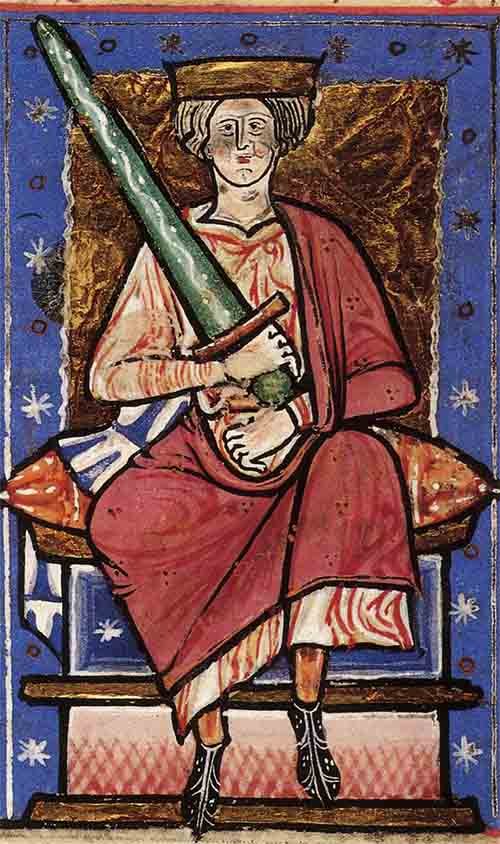
The Oxford Mint founded by Alfred the Great circa 871 AD
The Oxford Mint was first established in 871 AD by Alfred the Great. This makes it one of the oldest known British Mints.
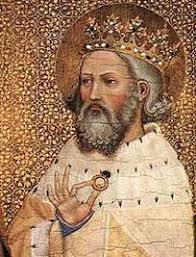
The Mint was a prolific producer of coinage under Alfred’s patronage and this continued through to Ethelred the Unready and the reign of the monarchs from the House of Wessex up until the reign of Edward the Confessor in 1066.
The Mint predominantly produced silver pennies during this period.
Stephen Penny, Cross Moline type, moneyer Swetig
William Penny, Bonnet type, moneyer Aelfpi
Henry lll Long Cross Pennies, moneyer Adam
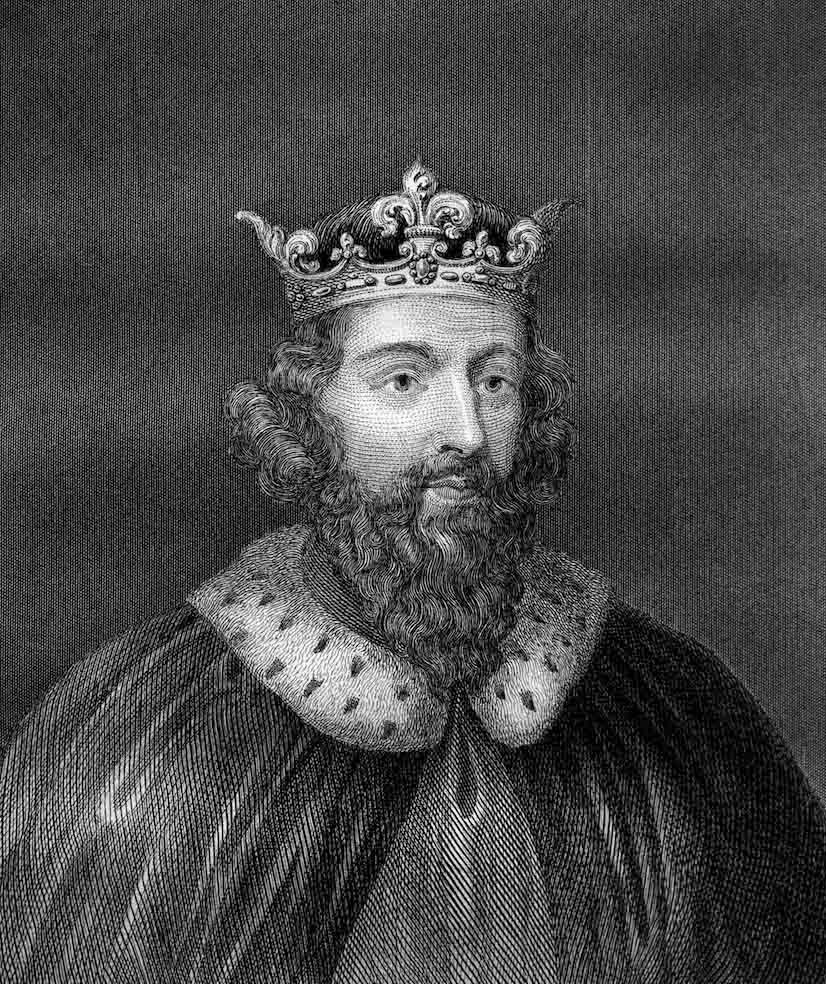
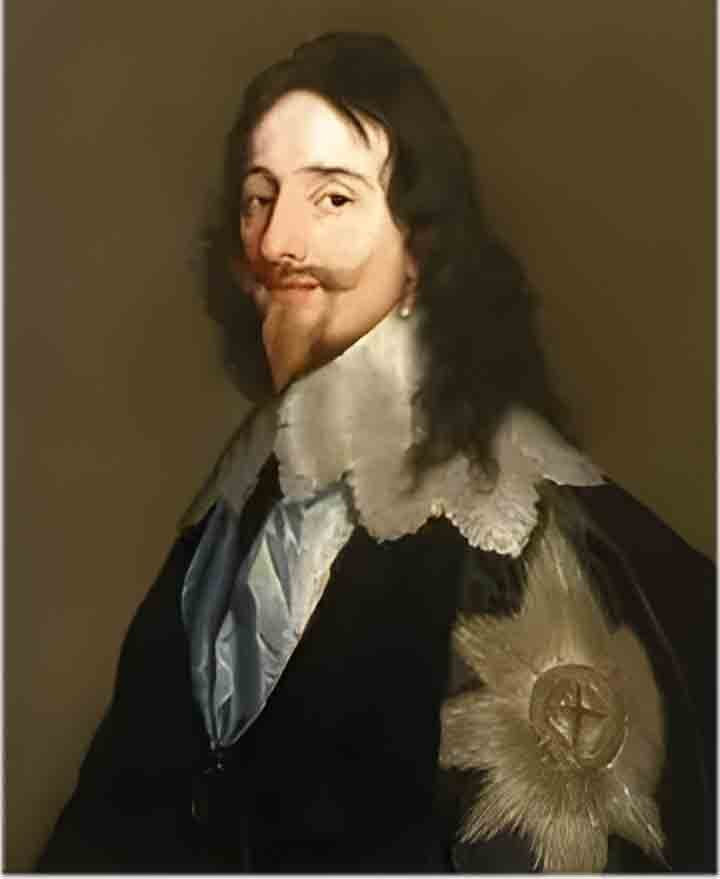
The Oxford Mint 1642 – Charles I
In January 1642 the ‘Long Parliament seized’ power in London and Charles was forced to move north. He reached Nottingham by late August but then, after the Battle of Edgehill, turned west to the Royalist Universities of the City of Oxford, he made a state entrance on 29th October 1642.
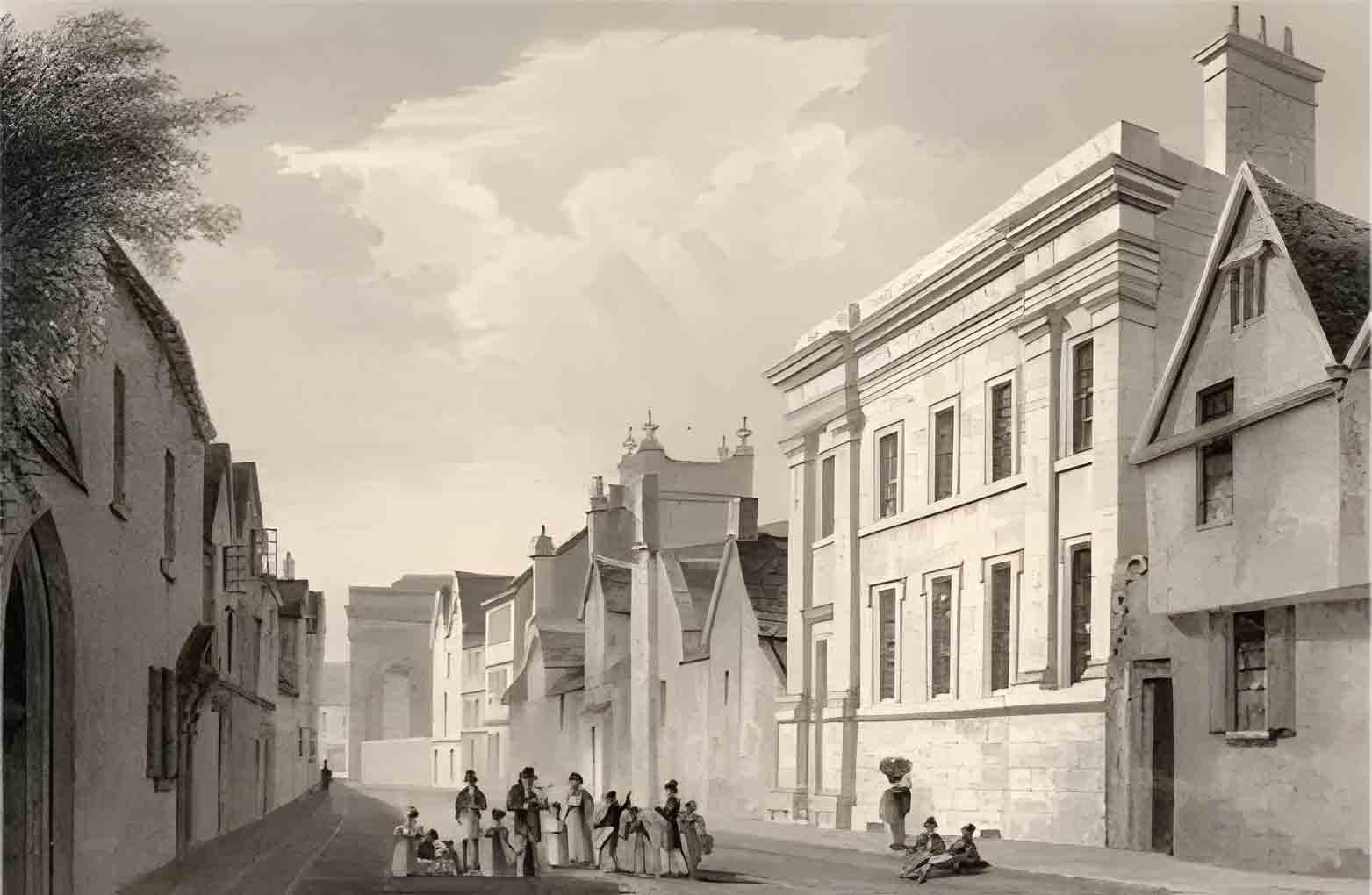
The King lived at Christ Church, with the Queen installed at Merton; the Royalist Parliament met in the Upper Schools and Great Convocation House; the Privy Council at Oriel; and The Oxford Mint worked at New Inn Hall (present day St Stephens College) from 3rd January 1643.
On the 26th of October the Civil War commenced with the battle of Edgehill and then followed the famous battles and sieges of Naseby, Newark and Oxford. Peace negotiations in Spring 1646 came to nought the war continued into a second phase when the Scots invaded in 1648.
During this time, it was the King’s sole right and prerogative to strike coins and to support the ‘Royal Cause’ and supporters’ plate, flatware, jewellery and any precious metal was donated to the king to turn into coin at The Oxford Mint to finance the Royalist war effort.
The Oxford Mint was overseen by Thomas Bushell and Sir William Pankhurst, former Wardens of the Shrewsbury and Tower Mints. Stocked with silver from Oxford and Cambridge colleges, and with converted foreign money, The Oxford Mint was a hugely successful enterprise and managed to cover Charles’s ample needs for coinage in his war effort.
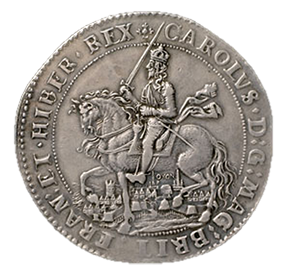
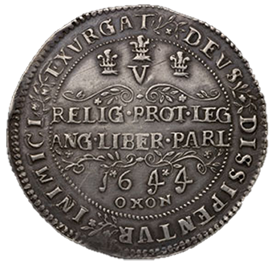
The Triple Unite of 1642 and The Oxford Crown of 1644 represents only a fraction of the production from the Mint during this period of its existence.
The Triple Unite 1642
The Triple Unite, valued at sixty shillings, or three pounds, was the highest English Hammered denomination to be produced. It was struck at the Oxford Mint set up during the first English Civil War of 1642-6 and issued between January and March of 1643 (although dated 1642). This huge coin (some 40mm in diameter) was issued, at least in part, for use as gifts to those whom the King wished to ‘cement’ to his side in the Civil War.
The coins minted in Oxford after the mint was hurriedly set up at New Inn Hall by Thomas Bushell in January 1643 at the beginning of the war were to procure men, arms, rent, supplies etc. for the war effort – but these large gold coins, the ultimate image of Royal Power, were primarily used to procure allegiance.
They were never intended to be saved and most were melted down at the end of the war to be turned into current coin – when the concept of ‘kingship’ changed forever. A few survived, perhaps a little more than two hundred and this rare and magnificent coin, the largest British hammered gold coin is truly emblematic of this troubled age and of the last king of England to rule by divine right.
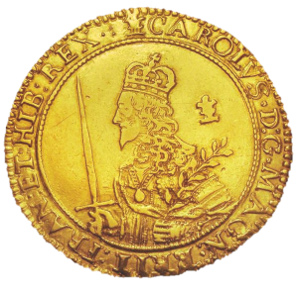
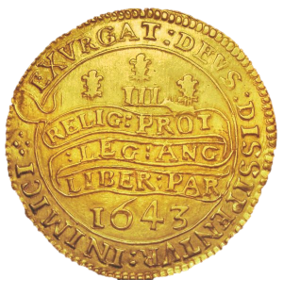
The obverse design for the coin features an armoured bust of Charles I, with broadsword raised, and yet in visual dichotomy, he bears an olive branch over his heart, Charles was visually appealing to either nature of the benefactor he was seeking to entice. The bust on this coin is very hawkish which is the earliest type, later he had it changed to a more benevolent and softer style. The abbreviated obverse legend translates as “Charles, by the Grace of God, King of Great Britain, France and Ireland. On the reverse, he put his famous declaration – uttered at Wellington in September 1642 when he swore to uphold the Protestant Religion, the laws of England and the freedom of Parliament. The outer reverse legend translates as “Let God arise and let his enemies be scattered.”
These magnificent gold coins were struck for only three dates, 1642, 1643 and 1644 with some variation as there are 24 different varieties of obverse and reverse across these three dates, plus an extremely rare 1642 piece struck in Shrewsbury. Today, it is estimated the 25 different combinations exist in a mere surviving sample of some 250 pieces.
When the Triple Unite was introduced as currency it was more than double the value of any previous English coin produced and would have been seen as a magnificent piece of propaganda against the Puritan cause, to show that though the King had moved from London, Oxford was a rich alternative City.
The Oxford Crown 1644